

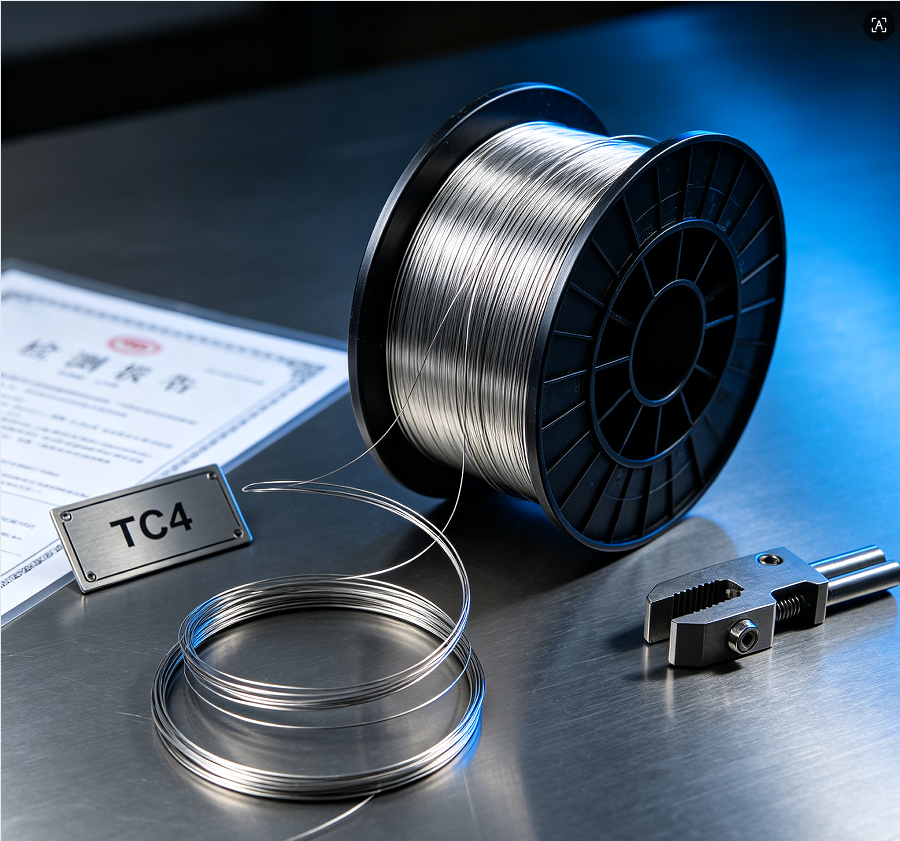
 Titanium wire boasts four irreplaceable advantages, corresponding to your production scenarios: **Biocompatibility, a necessity in the medical industry:** Pure titanium TA1/TA2 wire is non-toxic and non-allergenic, allowing direct bone tissue growth. It’s the sole designated raw material for orthodontic wire, orthopedic fixation wire, and surgical sutures, meeting ISO13485 medical certification standards. Stainless steel implants are prone to inflammation and cannot compare.
**Superior corrosion resistance, cost-effective for chemical and shipping industries for ten years:** It does not rust in strong acid, seawater, or chloride ion environments. Chemical filtration and seawater desalination equipment can operate for 20 years without replacement; ordinary steel wire corrodes and perforates within six months, resulting in significantly higher long-term costs.
**Lightweight and high-strength, a weight-reduction marvel in aerospace:** TC4 titanium alloy wire is twice as strong as stainless steel and 40% lighter. It’s used in aircraft engines, satellite supports, and rocket 3D printed parts. It withstands temperatures up to 600℃, is fatigue-resistant and not easily broken. 46% of the titanium material demand in aerospace orders comes from titanium wire.
High utilization rate and low cost: the preferred consumable for 3D printing.
WAAM arc additive manufacturing-specific titanium wire boasts a 95% material utilization rate and is 40-60% cheaper than titanium powder. Printing large aerospace components directly reduces raw material costs by half, making titanium wire the preferred choice for large-part processing over titanium powder.
II. Mainstream Titanium Wire Grades and Corresponding Industries: Direct Reference for Procurement to Avoid Buying the Wrong Material
Many procurement personnel cannot distinguish between TA pure titanium and TC titanium alloy wire, resulting in the scrapping of the entire batch due to purchasing the wrong material. A single table explains it all:
TA1/TA2 Pure Titanium Wire (GR1/GR2)
High corrosion resistance, good ductility, suitable for: chemical filters, seawater equipment, dental orthodontics, electroplating fixtures
TA9 Palladium Titanium Wire
Strong corrosion resistance, suitable for hydrochloric acid and highly corrosive chemical production lines
TC4 (Ti-6Al-4V) Titanium Alloy Wire
Industry sales leader, high strength and high temperature resistance, suitable for aerospace, automotive lightweighting, 3D printing, and general welding wire
TC4 ELI Low-Oxygen Medical Grade Titanium Wire
Low impurities, high toughness, specifically for orthopedic implants and human implant devices; FDA material reports available
TA15, TB8 High-Strength Titanium Wire
Military industry, customized special structural parts for high-end aerospace engines, ultra-high tensile strength
III. Four Fatal Pitfalls in Purchasing Titanium Wire, 90% Factory Experiences (Highly Interactive Core Insights)
Pitfall 1: Cheap Recycled Material Misrepresenting Virgin Titanium Ingots, Excessive Impurities
Cheap titanium wire is smelted from recycled titanium waste, resulting in excessive iron, oxygen, and carbon impurities: This leads to porosity during welding, easy cracking at high temperatures, and safety risks in medical components.
Identification Method: Request the manufacturer to provide an original material MTC test report before ordering, allowing traceability of the titanium ingot raw materials.
Pitfall 2: Non-compliant Wire Diameter Tolerances, Frequent Wire Jams on Automated Production Lines
Small workshops use outdated drawing equipment, with tolerances starting at ±0.05mm; precision equipment and 3D printing require tolerances of ±0.01mm, and fluctuations in wire diameter cause immediate shutdown.
Reputable Manufacturers: Fully imported precision wire drawing equipment, 0.03mm-10mm full specifications, straight wire/coiled wire with zero welding points.
Pitfall 3: Substandard surface treatment, with oxide scale and scratches hiding hidden dangers. Inferior titanium wire has a blackened surface and scratches, and is prone to oxidation and breakage under high temperature conditions; high-end products require a bright mirror surface without an oxide layer, and vacuum annealing is indispensable.
For those looking for a stable source of titanium wire, please comment with “sample” and we will send you a free sample of the corresponding material plus a complete set of material testing reports. There are no minimum order requirements!