
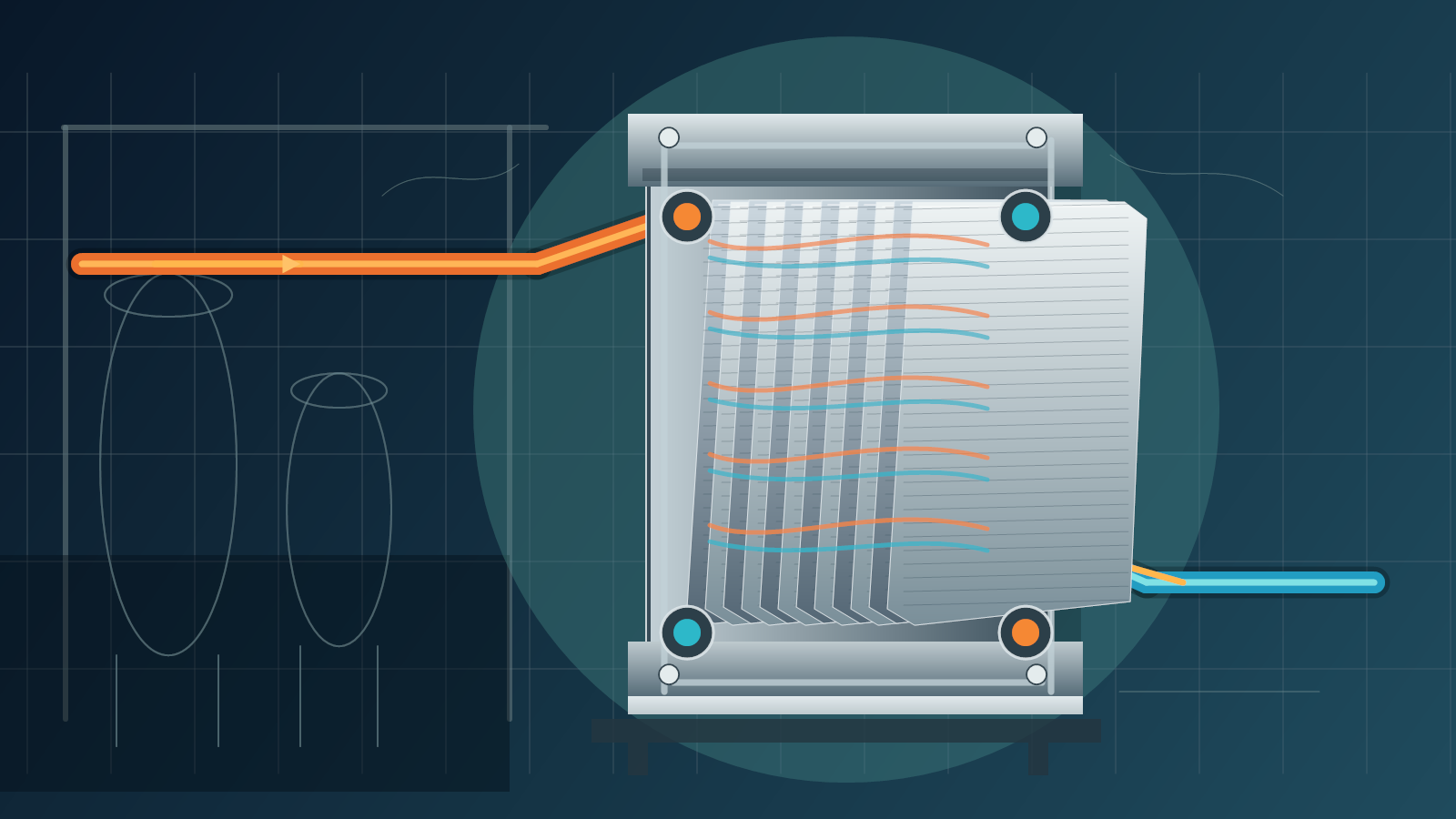
When a heat transfer system handles seawater, brine, chlorides, or aggressive process fluids, material selection is just as important as thermal design. A heat exchanger may be correctly sized and still suffer from premature failure if its wetted components cannot withstand the operating environment.
Titanium heat exchangers are widely selected for these demanding conditions because titanium combines strong corrosion resistance, mechanical durability, and a long service life. They are used in desalination plants, marine systems, chemical processing, power generation, aquaculture, and many other applications where conventional stainless steel or copper alloys may require more frequent maintenance.
This guide explains how titanium heat exchangers work, what makes them different, and what engineers should consider before choosing one.
What Is a Titanium Heat Exchanger?
A titanium heat exchanger transfers heat between two fluids without allowing them to mix. One fluid flows through one side of the exchanger while the second fluid flows through another side. Heat passes through a conductive wall, plate, or tube from the warmer fluid to the cooler fluid.
Titanium can be used in the components that come into contact with the process fluid, including:
– Heat transfer plates in a gasketed or welded plate heat exchanger
– Tubes and tube sheets in a shell and tube heat exchanger
– Headers, channels, covers, and selected internal components
– Customized parts for seawater, brine, or chemical service
The exact construction depends on the required flow rate, temperature, pressure, allowable pressure drop, cleanability, and space available.
Why Choose Titanium?
1. Excellent resistance to seawater and chlorides
Titanium forms a stable passive oxide layer that protects the metal from many corrosive environments. This makes it a strong candidate for seawater cooling, desalination, offshore equipment, and chloride-rich process streams.
Titanium is not universally corrosion-proof. Performance still depends on the fluid chemistry, temperature, concentration, velocity, deposits, crevice conditions, and the presence of contaminants. A proper material review is essential before final selection.
2. Long service life
The corrosion resistance of titanium can reduce the risk of leaks, wall thinning, and unplanned shutdowns. In the right application, this can produce a longer operating life and lower total maintenance requirements than a lower-cost material that needs more frequent replacement.
3. Compact and efficient construction
Titanium plate heat exchangers use thin plates with engineered corrugations. The corrugation pattern creates turbulence, increases heat transfer area, and supports a compact footprint. Titanium’s strength allows the use of thin, durable plates when the design is properly engineered.
Although titanium has lower thermal conductivity than copper, a well-designed plate or tube heat exchanger can still deliver strong overall thermal performance through thin walls, large effective surface area, and optimized flow channels.
4. High strength-to-weight ratio
Titanium provides high mechanical strength at a relatively low density. This can be valuable in marine, offshore, and modular systems where equipment weight and installation space matter.
5. Good resistance to erosion and biofouling-related damage
Titanium performs well in many high-flow water applications. Its resistance to erosion-corrosion can help protect the heat transfer surface when flow conditions are correctly controlled. In marine systems, the material is also often chosen to reduce concerns associated with copper-based alloys.
Common Types of Titanium Heat Exchangers
Titanium plate heat exchanger
A titanium plate heat exchanger contains a pack of thin, corrugated plates. Hot and cold fluids flow through alternating channels. Gaskets or welded seams separate the fluid circuits, depending on the design.
This type is often preferred when the system needs:
– High heat transfer in a small footprint
– Easy inspection and cleaning
– Flexible capacity expansion
– Low fluid volume
– Separation between seawater and freshwater or process water
Gasket selection is important. EPDM, NBR, FKM, and other elastomers each have different temperature and chemical compatibility limits.
Titanium shell and tube heat exchanger
A shell and tube heat exchanger uses a bundle of tubes installed inside a shell. One fluid flows through the tubes while the other flows around them inside the shell.
Titanium tube bundles are common in condensers, seawater cooling systems, power plants, and large industrial installations. Shell and tube designs can be well suited to high pressure, large flow rates, phase-change duty, and applications that require a robust mechanical layout.
Welded and customized titanium designs
For higher temperatures, demanding pressures, or fluids that are not compatible with gaskets, welded plate designs or customized titanium assemblies may be considered. The final construction should be based on a detailed thermal, mechanical, and corrosion assessment.
Where Are Titanium Heat Exchangers Used?
Titanium heat exchangers are suitable for many applications where corrosion resistance and reliability are priorities.
Desalination and water treatment
Desalination plants handle seawater, concentrated brine, and treated water. Titanium can be used in heat recovery systems, evaporators, condensers, and cooling loops where chloride exposure is significant.
Marine and offshore systems
Marine HVAC, shipboard cooling, offshore platforms, and seawater cooling circuits often require materials that can operate reliably in saltwater. Titanium helps reduce corrosion risk in compact equipment packages.
Chemical processing
Chemical plants may use titanium heat exchangers for acids, chlorides, and other aggressive media. The correct titanium grade and fabrication method must be verified against the complete process chemistry, including trace contaminants.
Power generation
Power plants use heat exchangers for condenser cooling, auxiliary cooling, and closed-loop heat rejection. Titanium tube bundles are particularly useful when seawater is used as the cooling medium.
Aquaculture and swimming pool systems
Titanium plate heat exchangers are often selected for saltwater aquaculture, seawater pools, and spa systems. They can help isolate the saltwater circuit from the heating or cooling circuit while maintaining a compact installation.
Food, pharmaceutical, and hygienic processes
Where the process fluid and hygiene requirements allow it, titanium heat transfer surfaces can be used in specialized heating and cooling systems. Hygienic design, surface finish, drainability, cleaning procedures, and applicable certifications should be confirmed for each project.
Titanium Compared with Other Heat Exchanger Materials
Material choice should be based on lifecycle performance rather than purchase price alone.
| Consideration | Titanium | 316L stainless steel | Copper alloys |
|—|—|—|—|
| Seawater and chloride resistance | Very strong in many services | Can be limited by temperature, chlorides, and crevices | Varies; may be unsuitable for some water chemistries |
| Initial equipment cost | Usually higher | Often lower | Varies |
| Weight | Low density | Higher density | Moderate |
| Thermal conductivity | Lower than copper | Moderate to low | High |
| Typical value | Long life in aggressive service | General industrial service | High-conductivity duties where chemistry permits |
The best material depends on the complete combination of fluid chemistry, operating temperature, pressure, velocity, fouling tendency, inspection requirements, and expected service life.
Key Selection Considerations
Before ordering a titanium heat exchanger, collect the following information:
1. **Fluid data:** Identify both fluids, chemical composition, chloride level, pH, solids, oil content, and any cleaning chemicals.
2. **Operating conditions:** Define inlet and outlet temperatures, design pressure, normal pressure, flow rate, and expected start-up or upset conditions.
3. **Thermal duty:** State the required heat load and whether the duty is sensible heating, sensible cooling, condensation, or evaporation.
4. **Pressure drop:** Set the maximum allowable pressure drop on each side. A lower pressure drop may require more heat transfer area.
5. **Fouling and maintenance:** Consider suspended solids, scale, biological growth, cleaning frequency, and whether the exchanger must be opened for inspection.
6. **Material compatibility:** Select the titanium grade, plate or tube thickness, gasket material, and connections as a complete system.
7. **Electrical isolation:** When titanium is connected to dissimilar metals in a conductive fluid, use suitable isolation and installation practices to reduce galvanic corrosion risk.
8. **Standards and documentation:** Confirm the required design code, pressure testing, material certificates, welding qualifications, and inspection records.
Accurate process data usually leads to a more reliable design and prevents oversizing, excessive pressure drop, or avoidable material costs.
Maintenance Best Practices
Titanium reduces corrosion risk, but it does not eliminate the need for maintenance. Good operating practice includes:
– Monitor inlet temperatures, outlet temperatures, flow rates, and pressure drop.
– Investigate changes in thermal performance before they become a shutdown issue.
– Keep strainers and upstream filtration in good condition.
– Follow the manufacturer’s cleaning procedure and chemical limits.
– Inspect gaskets, welds, tube sheets, connections, and supports during scheduled maintenance.
– Avoid unapproved tools or chemicals that can damage plates, gaskets, coatings, or adjacent materials.
– Check for deposits and biological growth when the exchanger operates with natural seawater or untreated water.
Preventive maintenance is particularly important because fouling can reduce heat transfer even when the titanium surface itself remains in good condition.
Final Thoughts
A titanium heat exchanger is a practical solution for heat transfer systems exposed to seawater, chlorides, brine, or other corrosive process conditions. Its main value comes from combining corrosion resistance with compact design, mechanical durability, and the potential for a long operating life.
The right choice still depends on engineering details. Fluid chemistry, temperature, pressure, flow velocity, heat load, fouling, gasket compatibility, and applicable standards should all be reviewed before the equipment is specified.
For a reliable selection, provide your operating data and ask the heat exchanger manufacturer to confirm the thermal design, pressure rating, material compatibility, and maintenance requirements for your application.