
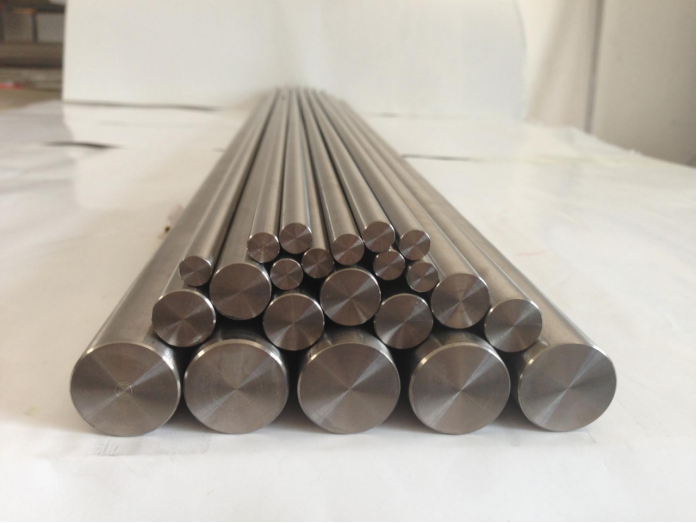
Titanium plays a vital role in modern industry due to its excellent physicochemical properties. It has low density, light weight, is non-magnetic, high strength, and excellent corrosion resistance, while also possessing good mechanical properties and weldability. The titanium rods produced by our company are widely used in chemical equipment, seawater desalination, ship components, electroplating, and other industries. Titanium’s corrosion resistance is approximately 10 times that of ordinary stainless steel, and its good biocompatibility and low rejection rate in the human body also make it widely used in the manufacture of implants and medical devices.
To ensure product quality and safety, the production and acceptance of titanium rods must strictly adhere to the following national and company internal standards:
- Chemical Composition Requirements
The chemical composition of titanium and titanium alloy rods must comply with GB/T 3620.1. If the buyer requests retesting, the permissible deviation in chemical composition shall be in accordance with GB/T 3620.2 to ensure the stability and compliance of the material composition.
- Dimensions and Tolerances: The diameter or side length of hot-worked bars and their tolerances must comply with the company’s internal technical specifications to ensure product suitability in subsequent processing and use.
- Surface Finish Accuracy: For bars that have undergone hot working followed by turning (grinding), as well as bars formed by cold rolling or cold drawing, the diameter tolerance must meet the company’s internal control technical specifications to ensure dimensional accuracy meets the requirements of high-end applications.
- Shape Tolerances: For hot-worked bars that have undergone turning (grinding), the out-of-roundness (ovality) must not exceed half of the dimensional tolerance to ensure consistency in precision assembly.
- Length Specifications: The unspecified length of processed bars ranges from 300 mm to 6000 mm, and the unspecified length of annealed bars ranges from 300 mm to 2000 mm. For fixed-length or multiple-length deliveries, the length should fall within the corresponding unspecified length range to meet the customized needs of different customers.