
This comprehensive guide compares the two materials in terms of chemical composition, mechanical properties, corrosion resistance, processing characteristics, cost, and typical applications to help engineers and procurement professionals make informed decisions.
1. Basic Introduction to GR2 and GR5 Titanium Bars
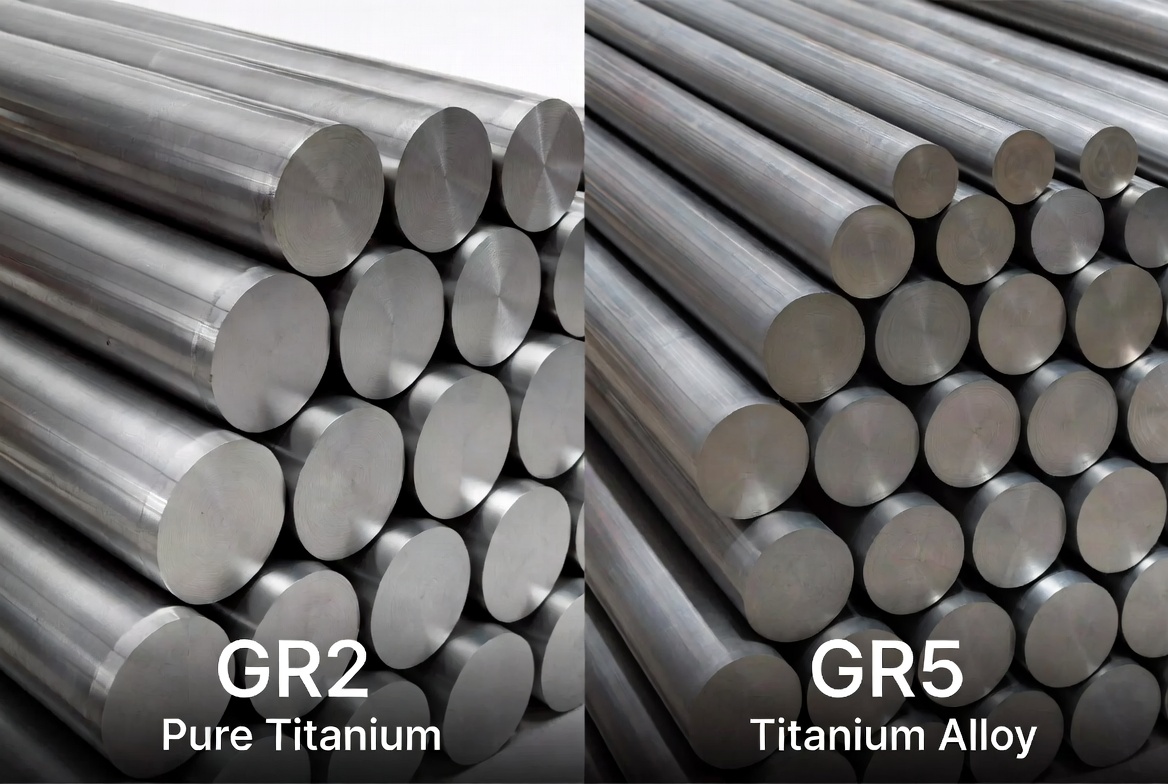
Commercially Pure Titanium Bars (Mainly GR2 / TA2) GR2 is the most commonly used commercially pure titanium grade, containing ≥99% titanium. It belongs to the α-phase titanium family and offers excellent corrosion resistance and formability.
GR5 Titanium Alloy Bar (Ti-6Al-4V / TC4) GR5 is an α+β titanium alloy created by adding 6% aluminum and 4% vanadium to pure titanium. It is the most widely used titanium alloy worldwide, often referred to as “6-4 Titanium.”
2. Performance Comparison Table
| Property | GR2 Pure Titanium Bar | GR5 Titanium Alloy Bar (TC4) | Winner |
|---|---|---|---|
| Chemical Composition | Ti ≥ 99.2% | Ti + 6%Al + 4%V | – |
| Density (g/cm³) | 4.51 | 4.43 | GR5 (lighter) |
| Tensile Strength (MPa) | 345–450 | 895–1100 | GR5 |
| Yield Strength (MPa) | 275–380 | 828–950 | GR5 |
| Elongation (%) | 20–30 | 10–15 | GR2 |
| Hardness | HRB 70–80 | HRC 30–36 | – |
| Corrosion Resistance | Excellent (especially oxidizing media) | Good | GR2 |
| Max Working Temperature | ≈315°C | ≈400–450°C | GR5 |
| Fatigue Strength | Moderate | Excellent | GR5 |
| Weldability | Excellent | Good (requires protection) | GR2 |
| Machinability | Excellent (easy cold forming) | Moderate (needs hot forming) | GR2 |
| Relative Price | Lower | 40–80% higher | GR2 |
Data based on ASTM B348, AMS 4928, and industry testing.
3. Detailed Performance Differences
Strength & Weight GR5 offers more than 2.5 times the tensile strength of GR2. This allows significant weight reduction in structural components, making it the preferred choice in weight-sensitive industries.
Corrosion Resistance GR2 performs better in seawater, wet chlorine, nitric acid, and other oxidizing environments due to its stable and dense oxide film. GR5 may require additional protection in strongly reducing acids or fluoride-containing media.
Processing & Welding GR2 has superior ductility, making it easier to bend, stamp, and weld. GR5 is stronger but less ductile, typically requiring hot working and more careful welding procedures.
High-Temperature Performance GR5 maintains good strength at temperatures up to 400–450°C, while GR2 strength drops more rapidly above 300°C.
4. Recommended Applications
Choose GR2 Pure Titanium Bars for:
- Chemical equipment (reactors, heat exchangers, pipelines)
- Marine engineering and seawater desalination
- Medical implants (non-load-bearing parts)
- Food & pharmaceutical industries (high hygiene requirements)
- Architectural decoration and titanium dioxide production equipment
Choose GR5 Titanium Alloy Bars for:
- Aerospace (aircraft structural parts, fasteners, engine components)
- Medical devices (artificial joints, dental implants, surgical tools — medical-grade GR5 ELI)
- Automotive and motorsports (high-performance parts)
- High-pressure petrochemical equipment
- Defense, deep-sea submersibles
- High-strength titanium bolts, shafts, and valves
Hybrid Solution Recommendation: Many projects use GR2 for corrosion-resistant outer parts and GR5 for high-strength core components to achieve the best balance of performance and cost.
5. Quick 3-Step Selection Process
- Environment First: Strong corrosion or oxidizing media (seawater, chlorides) → Prioritize GR2.
- Strength & Temperature: High stress, fatigue, or high temperature (>300°C) → Prioritize GR5.
- Budget & Processing: Cost-sensitive or requires extensive cold forming/welding → GR2.
6. Procurement Tips
- Always request materials compliant with ASTM B348, GB/T 2965, or equivalent standards.
- Demand full material test certificates (chemical analysis, mechanical properties, ultrasonic testing).
- Surface conditions: pickled, polished, peeled, or forged — choose according to application.
- Common sizes: Diameter Φ6mm to Φ400mm, length customizable.
- Partner with factories that control the full production chain (melting – forging – machining) for batch consistency.
Conclusion
There is no absolute “better” between GR5 titanium alloy bars and GR2 pure titanium bars — only the most suitable choice for your specific working conditions. Understanding these differences helps achieve optimal performance while controlling costs effectively.
We are a professional titanium manufacturer in China with a complete titanium bar production line. We stably supply high-quality GR2 pure titanium bars, GR5 (TC4) titanium alloy bars, and custom processing services.
Contact us for free technical selection advice and competitive quotes.
Tel/Fax:+86-917-5720181
Email: inquiry@ydtitanium.com
Phone/Whatsapp: +86 13571749697