
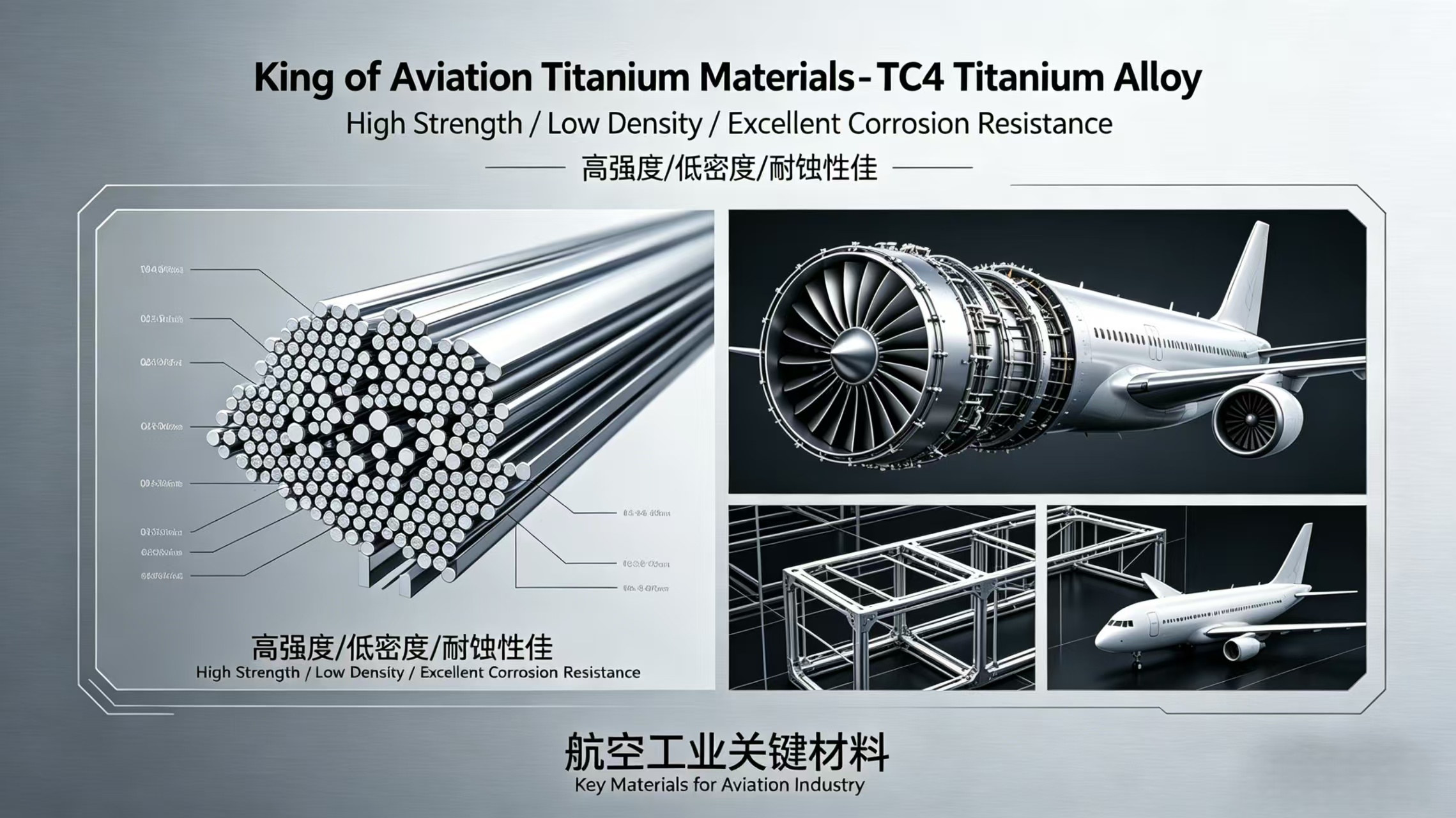
TC4 (international designation Ti-6Al-4V) is a classic α+β type two-phase titanium alloy. Since its successful development in the United States in 1954, it has long accounted for over 80% of the global aerospace titanium alloy usage, making it the undisputed “king of titanium alloys.”
Its dominance in the aerospace field is essentially due to the fundamental rationality of its compositional design, the ultimate balance of its comprehensive performance, and the mature adaptability of its entire process, perfectly matching the core requirements of aerospace equipment: “lightweight, high reliability, wide operating conditions, and full-chain controllability.”
Core Performance Characteristics of TC4 Titanium Alloy
- Ultimate Balance of Strength and Toughness, Ranked Among the Top Tier of Aerospace Structural Materials
TC4’s compositional design is highly rational: 6% Al acts as an α-phase stabilizing element, significantly improving the room temperature strength and thermal stability of the matrix through solid solution strengthening; 4% V acts as a β-phase stabilizing element, optimizing the alloy’s plasticity and toughness, achieving a precise balance of the α+β two-phase structure. Annealed state core mechanical properties: tensile strength ≥895MPa, yield strength ≥825MPa, elongation ≥10%, reduction of area ≥25%, fracture toughness 50-70MPa・m¹/²; Specific strength reaches 23.5, far exceeding ordinary alloy steel (<18), and among commonly used aerospace structural materials, it is only lower than high-end carbon fiber composites. Furthermore, its impact resistance is far superior to composite materials, making it an ideal material for aerospace main load-bearing components.
This characteristic of “high strength without sacrificing toughness” perfectly matches the core service requirements of aerospace components: “to withstand static and impact loads while resisting crack propagation.”
- Wide Temperature Range Service Stability, Covering the Entire Temperature Range of Aerospace Operations
TC4’s service temperature range covers -196℃ to 350℃, making it one of the very few metallic materials capable of simultaneously maintaining performance in both ultra-low and intermediate temperatures:
Intermediate Temperature Performance: It can maintain stable service for extended periods below 350℃, with a strength retention rate exceeding 80% at 400℃, fully meeting the service requirements of cryogenic compressor sections in aero-engines and aerodynamic heating components in fuselages;
Cryogenic Performance: In ultra-low temperature environments of liquid hydrogen and liquid oxygen (-196℃), it exhibits no cryogenic brittleness, maintaining good plasticity and toughness, making it suitable for extreme environment components such as cryogenic fuel tanks in spacecraft.
- Excellent fatigue resistance and environmental adaptability ensure long service life.
Over 90% of failures in aerospace structural components originate from fatigue damage. TC4’s fatigue resistance is one of its core advantages in aerospace applications: Its high-cycle fatigue limit in the annealed state reaches 500-650 MPa. After surface modification treatments such as shot peening, fatigue strength can be increased by 30%-50%. Its high-frequency cycle life exceeds 10⁷ cycles, fully meeting the long-term cyclic load service requirements of aircraft takeoff and landing and engine rotating components.
It exhibits excellent corrosion resistance and stress corrosion cracking resistance in common aerospace media such as atmosphere, fuel, and hydraulic oil, allowing for long-term service without additional protection, significantly reducing maintenance costs for aerospace equipment and improving overall life-cycle reliability.
- Excellent heat treatment control performance, enabling customized performance matching
TC4 is a heat-treatable two-phase titanium alloy. By adjusting the heat treatment process, its performance can be precisely controlled within a wide range to meet the differentiated needs of various aerospace components:
* Annealing (700-850℃): Eliminates internal stress, stabilizes the microstructure, and improves plasticity and dimensional stability, suitable for fuselage skins, thin-walled parts, etc., where high plasticity and formability are required;
* Solution treatment + aging treatment: Rapid cooling through solution treatment in the two-phase region, combined with medium-temperature aging to precipitate fine and dispersed α phase, can increase tensile strength to over 1000MPa, balancing strength and toughness, suitable for high-strength load-bearing components such as landing gear and joints.