
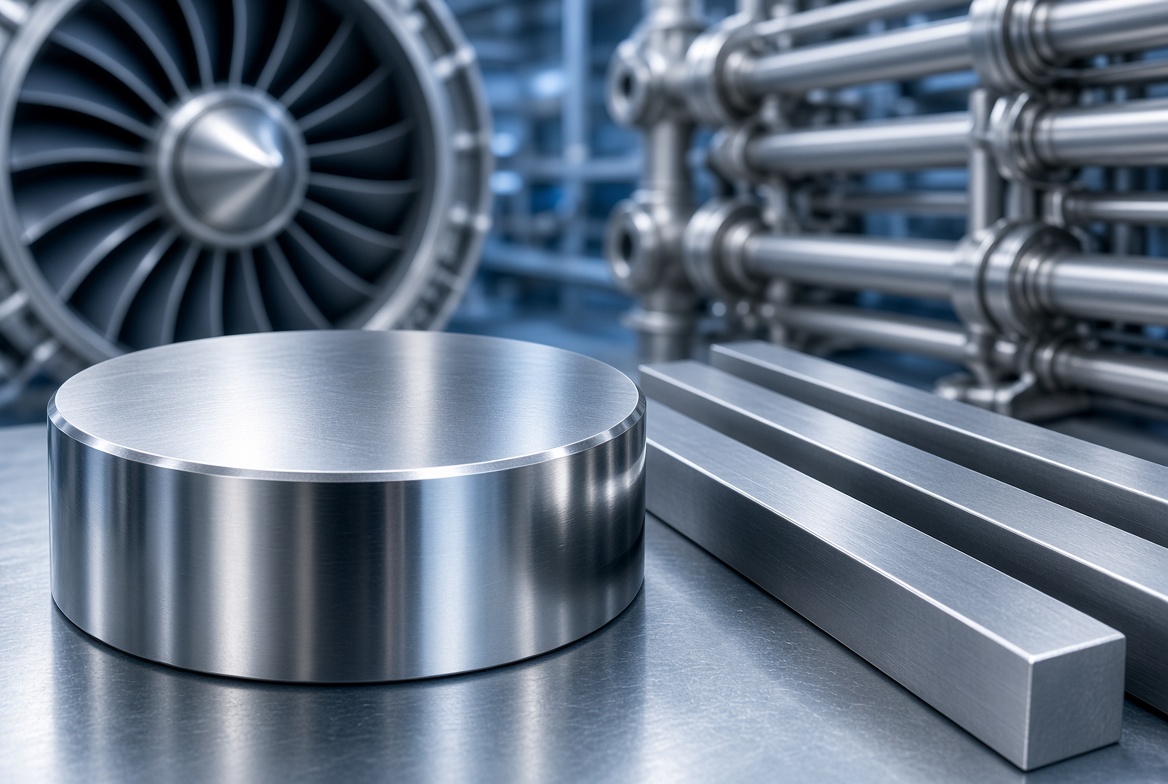
Titanium and its alloys play a critical role in modern aerospace engineering due to their exceptional combination of high strength-to-weight ratio, excellent corrosion resistance, and good performance at elevated temperatures. These properties make titanium an indispensable material in both commercial aviation and space exploration.
Key Advantages of Titanium in Aerospace
- High Strength-to-Weight Ratio: Titanium alloys offer strength comparable to many steels while being approximately 40–45% lighter. This weight reduction directly improves fuel efficiency and payload capacity.
- Corrosion Resistance: Titanium forms a stable, protective oxide layer, providing outstanding resistance to atmospheric corrosion, salt water, and many chemicals.
- Heat Resistance: Certain titanium alloys maintain good mechanical properties at temperatures up to 500–600°C, making them suitable for engine and high-temperature structural components.
- Fatigue and Crack Resistance: Titanium demonstrates excellent fatigue performance, which is essential for aircraft structures subjected to cyclic loading.
Major Applications in Aircraft
1. Airframe Structures
- Fuselage frames, bulkheads, and wing structures
- Landing gear components
- Engine pylons and support structures
Common alloys: Ti-6Al-4V (Grade 5), Ti-6Al-4V ELI
2. Engine Components
- Compressor blades, discs, and casings
- Fan blades and low-pressure turbine parts
- Exhaust systems and afterburner components
Common alloys: Ti-6Al-4V, Ti-6Al-2Sn-4Zr-2Mo, Ti-5Al-2.5Sn
3. Fasteners and Hydraulic Systems
- High-strength bolts, nuts, and rivets
- Hydraulic tubing and fittings
Titanium fasteners significantly reduce weight compared to steel equivalents while maintaining required strength.
Applications in Spacecraft and Launch Vehicles
- Propellant tanks and pressure vessels
- Structural frames and support brackets
- Heat shields and thermal protection system components
- Rocket engine parts (including some combustion chamber and nozzle components)
Titanium’s resistance to cryogenic temperatures also makes it suitable for liquid hydrogen and liquid oxygen systems.
Commonly Used Titanium Grades in Aerospace
| Grade / Alloy | Key Characteristics | Typical Applications |
|---|---|---|
| Ti-6Al-4V (Grade 5) | Most widely used, high strength | Airframes, engine parts, fasteners |
| Ti-6Al-4V ELI | Improved fracture toughness | Critical structural components |
| Commercially Pure (Grades 1–4) | Excellent corrosion resistance | Hydraulic tubing, non-structural parts |
| Ti-6Al-2Sn-4Zr-2Mo | Better high-temperature performance | Engine components |
Future Trends
As the aerospace industry continues to pursue lighter, more fuel-efficient, and longer-lasting aircraft, the demand for titanium is expected to remain strong. Advances in additive manufacturing (3D printing) of titanium alloys, improved processing techniques, and the development of new high-temperature titanium alloys are further expanding its applications in next-generation aircraft and spacecraft.
In summary, titanium remains one of the most important structural materials in aerospace due to its unique balance of strength, weight, and durability. Its continued use will be essential for improving aircraft performance and enabling future space exploration missions.